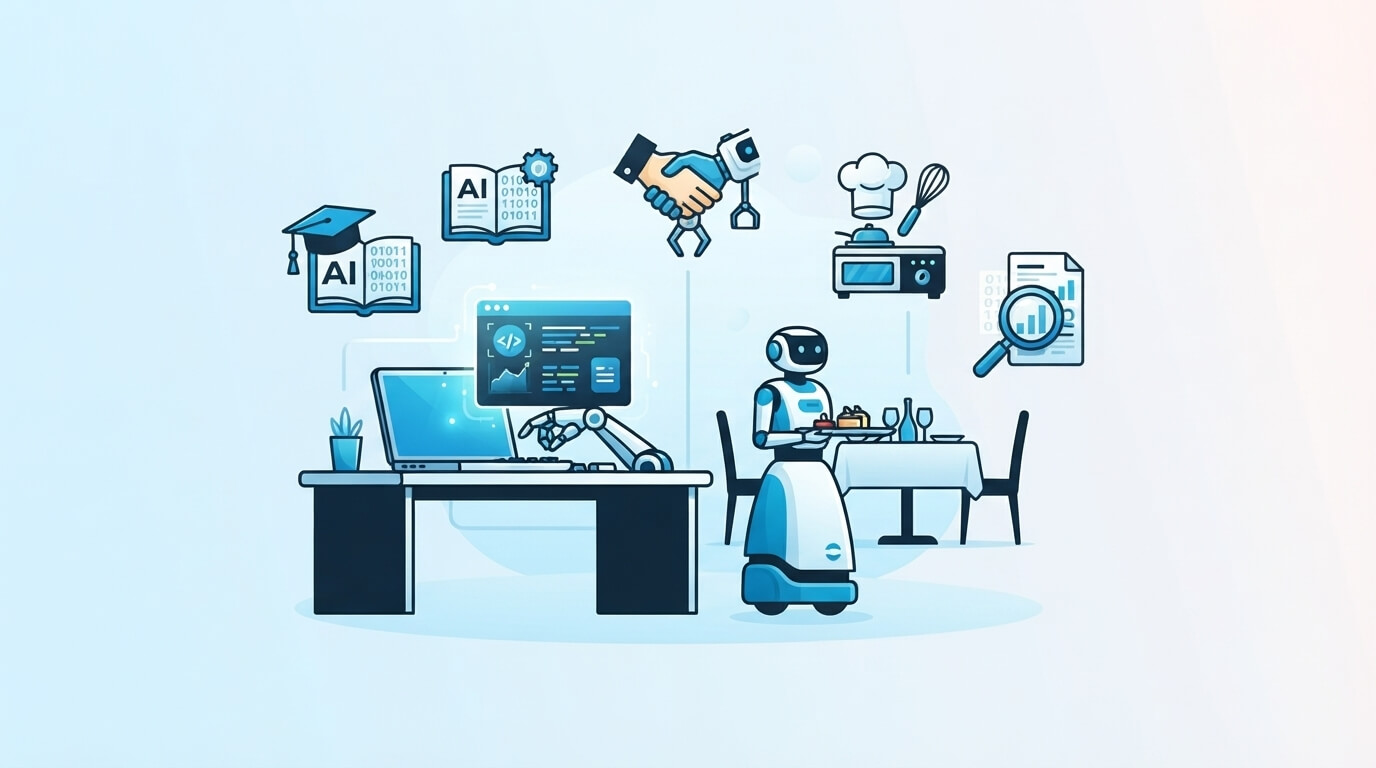
For decades, automation mostly meant heavy factory machinery bolted to warehouse floors. Today, the landscape looks very different. We are entering a two-stage shift in how everyday work gets done: first through intelligent software (Artificial Intelligence) transforming screen-based careers, and second through affordable, general-purpose robots stepping into physical workplaces.
Rather than happening overnight, job replacement is unfolding gradually—starting with repetitive tasks and expanding as technology becomes cheaper and more reliable. Understanding which roles are most exposed helps business owners, students, and working professionals plan ahead before their industry shifts beneath them.
Wave 1: Knowledge, Screen-Based & Service Jobs Replaced by AI
The first wave is already underway. Modern AI models can write code, analyze financial records, tutor students, and answer customer queries faster—and at a fraction of the cost—of traditional workflows. As a result, several familiar white-collar professions are shrinking or restructuring rapidly:
- Junior Software Developers & Manual QA Testers: Routine coding, website layout generation, bug fixing, and repetitive software testing are increasingly handled by AI coding assistants. While senior architects who design complex systems remain essential, companies need far fewer entry-level programmers to write standard boilerplate code.
- Accountants, Bookkeepers & Payroll Clerks: Automated accounting platforms can already read invoices, reconcile bank statements, flag anomalies, and generate tax summaries in seconds. Routine bookkeeping and data-heavy compliance work are among the easiest office roles for AI to absorb.
- Teachers & Private Tuition Masters: While younger school children still need human supervision and emotional guidance, standardized exam coaching and private tutoring face major disruption. AI tutors can now explain math, science, and languages step-by-step, adapt to a student’s exact pace, and run 24/7 for a tiny monthly subscription.
- Customer Support, Telemarketers & Data Entry Staff: Call centers, live-chat support, appointment scheduling, and invoice processing are rapidly moving to conversational AI agents that speak natural languages and never take a day off.
- Translators, Copywriters & Basic Graphic Designers: Routine content drafting, product descriptions, translation, and standard marketing visuals are now generated in seconds, leaving human creatives focused mostly on high-level brand strategy.
Wave 2: Physical & Skilled Hands-On Jobs Replaced by Affordable Robots
For years, hands-on jobs felt safe from automation because software could not fold laundry, carry plates, or plug in a network cable. That barrier is disappearing fast. As manufacturing scale drives down the cost of autonomous service bots and humanoid robots—much like what happened with electric vehicle batteries—a second layer of physical jobs will face replacement:
- Waiters & Food Delivery Runners: Tray-carrying delivery robots are already a common sight in restaurants, hotels, and food courts across Asia and beyond. As prices drop further, automated table service and self-ordering kiosks will become standard in casual dining.
- Short-Order Chefs & Repetitive Kitchen Staff: Restaurants that serve standardized menus—such as burgers, fried dishes, noodles, pizzas, or coffee—are prime targets for robotic kitchen arms and automated cooking stations that measure ingredients precisely and cook every batch identically.
- Receptionists & Front-Desk Concierges: AI-powered lobby kiosks and greeting robots equipped with voice recognition and facial cameras can already check in visitors, issue access passes, answer building FAQs, and notify hosts without human intervention.
- IT Hardware Technicians & Data Center Support: Routine hardware tasks—such as swapping failed server drives, running cable diagnostics, assembling standard desktop units, and resetting rack equipment—are steadily moving toward automated robotic maintenance inside modern data centers.
- Warehouse Pickers, Cleaners & Security Guards: Autonomous floor scrubbers, robotic night-patrol units with thermal cameras, and warehouse picking bots already work 24-hour shifts without fatigue.
- Retail Cashiers & Stock Clerks: Between smart self-checkout lanes, automated shelf-scanning robots, and cashierless store sensors, traditional retail floor staffing continues to shrink.
Which Jobs Will Hold Out the Longest?
Even as AI and robots become more capable, not every profession can be easily automated. Roles that require unpredictable physical problem-solving in messy, real-world spaces—such as residential plumbers, electricians repairing older homes, and emergency mechanics—are far harder for robots to navigate than clean restaurant floors or structured office desks.
Similarly, professions built on deep human trust, empathy, and high-stakes accountability—such as surgeons, nurses, therapists, hands-on tradespeople, and business leaders who manage complex human relationships—will remain anchored by real people for a long time to come.
How to Prepare Before the Shift Accelerates
The biggest mistake anyone can make right now is assuming their current job description will look the same five years from now. Whether you work in IT, education, finance, or hospitality, the safest path forward is to move closer to the tools rather than competing against them.
Learn how to supervise, configure, and troubleshoot AI workflows in your field. Focus on client communication, judgment, and real-world problem-solving—the exact areas where automated software and standardized robots still fall short. Just like shifting early to modern electric vehicles before petrol resale values drop, adapting your skills early keeps you ahead of the curve instead of catching up after the market has already moved on.
Ready to get your business online?
If you have rough notes and a few photos ready, we can turn them into a clean, affordable, and easy-to-manage website.
Discuss Your Project →